There’s a number in the latest Give.org Donor Trust Report that should stop every nonprofit leader mid-scroll. Nearly 70% of people say they have to trust a charity before they’ll donate. Only about 20% say they actually have high trust in charities. So if you’re trying to figure out how to build donor trust, start there.
Here’s the part that makes it fixable instead of depressing. The same research found that openness to giving hit its highest levels since 2017 across 2024 and 2025. People want to give. The findings, based on a December 2025 survey of more than 1,500 U.S. adults, point to a holdup that isn’t apathy. It’s uncertainty about who deserves the trust.
So the question stops being “how do we make people care” and becomes something far more useful: how do we prove we’re worth it before someone clicks away.
Where donors actually go to decide
When people said they look for information before giving, two sources came out on top: charities’ own websites and third-party evaluators like Charity Navigator and BBB’s Give.org. Personal outreach and plain web searches mattered too, but your website sat at the front of the line.
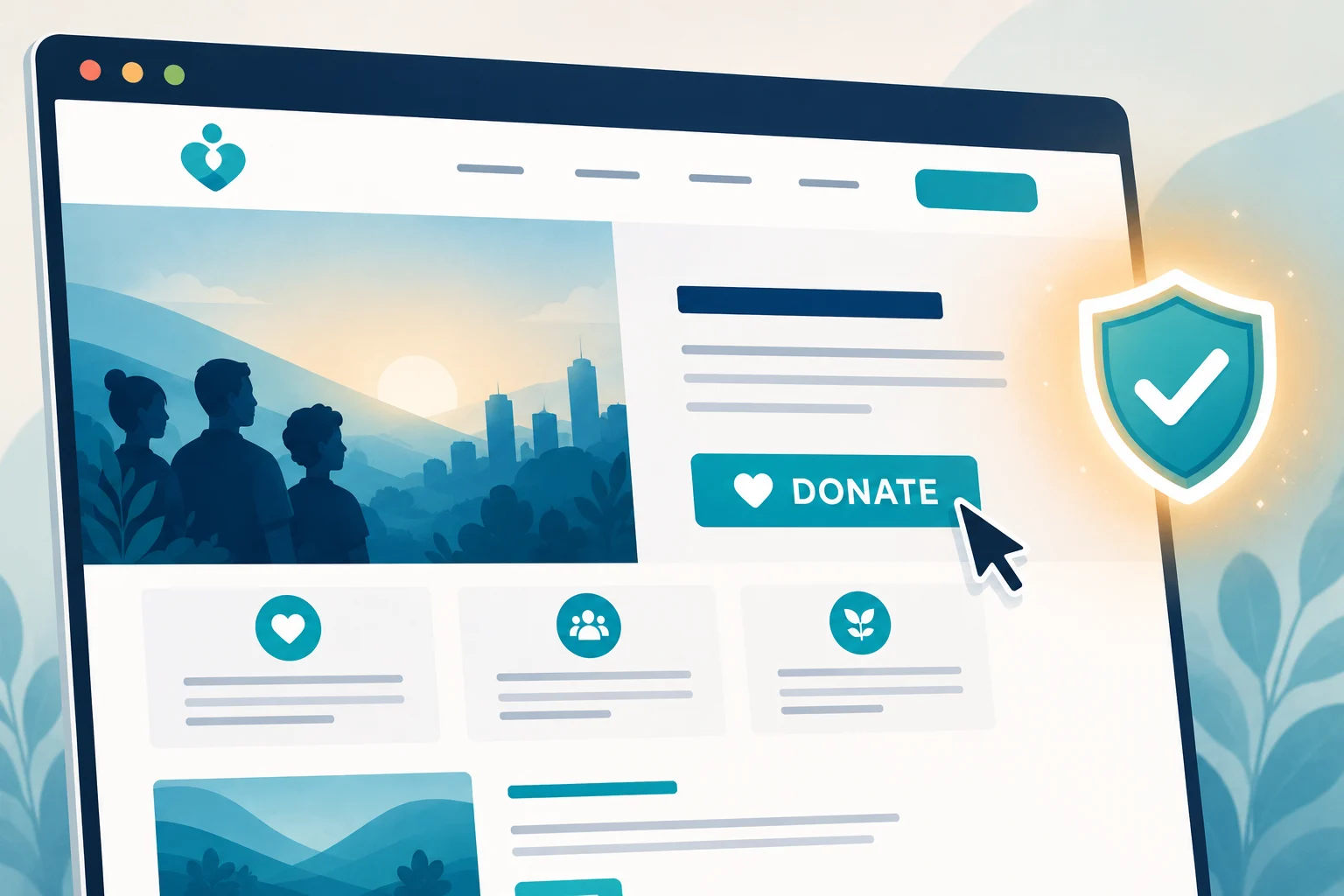
That changes what your website is for. It isn’t a brochure. It isn’t a place to park your logo above a donate button. It’s the room where a stranger decides whether you’re real, competent, and worth their money. Most of them make that call in seconds, long before they’ve read your case statement.
What it takes to build donor trust on a page
Donors don’t fill out a trust scorecard. They form a gut read in the first few seconds, and four things drive it whether they notice or not.
The first is how the site looks. A clean, current design reads as a well-run organization. A dated one, with stretched logos and clip art, quietly says the opposite, and it says it about your whole operation, not just your homepage. Fair or not, people judge the cause by the craft of the page.
The second is speed. A site that takes five seconds to load loses a chunk of visitors before they see anything, and the ones who stay register the lag as neglect. Slow feels untrustworthy even when nobody could tell you why.
The third is accessibility. If your site breaks for someone using a screen reader, or the text is unreadable on a phone, you’ve lost that donor and signaled that you didn’t think about them. An accessible site is both wider reach and a trust signal in its own right, because it shows you sweat the details.
The fourth is the information itself. Donors want to see where the money goes, what the work actually produces, and that there are real people behind it. Clear financials, specific impact, named staff, and an easy way to get in touch do more for trust than any tagline. Vague beats nothing, but specific beats vague every time.
The framework matters more than any single page
You can write the most honest impact report in the sector and still lose the gift if it lives on a site that loads slowly, looks tired, or falls apart on mobile. Trust is cumulative. Every element either adds to it or chips at it, and a weak foundation undermines good content sitting on top of it.
That’s why the fix starts with the framework, not a fresh coat of paint. A site built to be fast, accessible, and structured around the information donors are looking for does the trust work continuously, on every visit, without you thinking about it. Get that right and your content, your campaigns, and your appeals all land on solid ground.
The catch has always been cost. A site built to be fast, accessible, and structured around the information donors are looking for does the work of building donor trust continuously, on every visit, without you thinking about it.
That’s the problem we built Launchpad to solve: a custom site engineered to build donor trust through speed, accessibility, and the right information, launched in weeks instead of months, for a fraction of the usual price. Enterprise hosting, accessibility monitoring, and SEO are wired in from day one, and yes, it works for nonprofits, Google Ad Grant included. The demand for your mission is already there. Make sure your website is ready to earn it. See what it would cost for your organization.