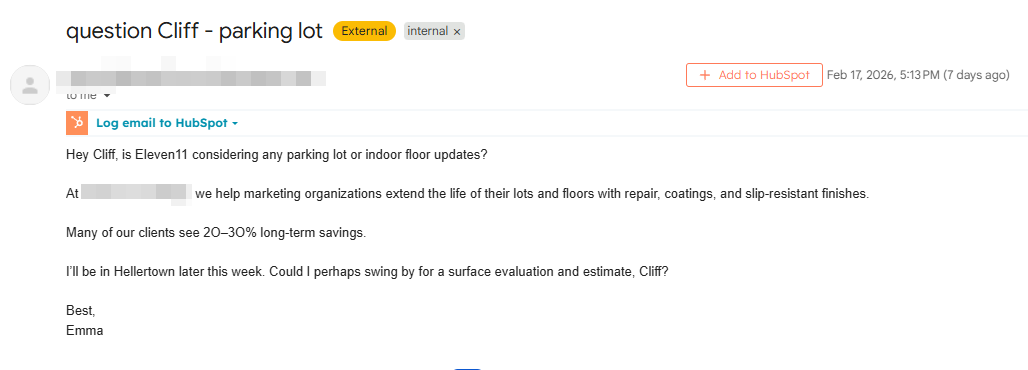
Last week, an email landed in my inbox with the subject line “question Cliff – parking lot.” Emma from a coatings company wanted to know if Eleven11 was considering any parking lot or indoor floor updates. She even offered to swing by our office in Hellertown for a free surface evaluation.
There are a few problems here.
First, we don’t have a parking lot. We’re a digital marketing agency. Our “office” is a collection of laptops scattered across the country. Second, I’m writing this from Florida. Hellertown is where we’re incorporated, but nobody is sitting in a building there waiting for Emma to show up with a surface evaluation kit. And third (and this is the big one), why would a company that specializes in helping “marketing organizations” with their parking lots assume that a digital agency has flooring needs?
Emma did some things right. She used my name. She referenced our location. She kept it short. But all of that personalization falls apart when the core targeting is wrong. It’s like addressing a beautifully handwritten letter to the wrong house.
And here’s the thing: we all send emails like this. Maybe not about parking lots, but we’ve all been guilty of treating a send list like a suggestion rather than a strategy.
This Isn’t Just a Cold Email Problem
It’s easy to laugh at a bad prospecting email and move on. But the same targeting mistake happens every day in email marketing, and the consequences are bigger than one ignored pitch.
If you’re a nonprofit blasting the same newsletter to every donor on your list, you’re making the same mistake Emma made. You’re assuming everyone in your database has the same needs, the same relationship with your organization, and the same reason to care. They don’t.
If you’re a B2B company sending product updates to leads who signed up for a webinar six months ago and never came back, you’re doing the Emma. If you’re a B2C brand emailing winter coat promotions to your customers in Miami, you get the idea.
The channel doesn’t matter. Cold outreach, warm nurture sequences, monthly newsletters. The principle is the same: sending the right message to the wrong person is almost as bad as sending no message at all.
What Good Targeting Actually Looks Like
Good targeting isn’t complicated, but it does require you to slow down and think before you hit send.
Start with your segments, not your message. Most people write the email first and then figure out who to send it to. Flip that. Who are you trying to reach, what do they care about, and where are they in their relationship with you? Answer those questions before you write a single word.
Use the data you already have. You don’t need a fancy AI tool to segment your list. Most email platforms let you filter by location, engagement history, purchase behavior, donation history, or signup source. If someone hasn’t opened an email in six months, they probably shouldn’t get the same message as someone who clicked three links last week.
If you’re going to personalize, verify. This is where Emma went wrong. She had my name and our city. That’s a good start. But she didn’t check whether we actually had a physical office, or whether a marketing agency would need floor coatings. Personalization without accuracy is worse than no personalization at all, because it signals that you didn’t actually do your homework. You just plugged variables into a template.
Test small before you send big. If you’re launching a new segment or trying a new angle, send it to a small group first. See what happens. Adjust. Then scale. This is especially important for nonprofits running re-engagement campaigns or businesses launching into a new vertical.
The Real Cost of Bad Targeting
Bad targeting doesn’t just mean your email gets ignored. It actively hurts you.
Your sender reputation takes a hit every time someone marks your email as spam or ignores it entirely. Over time, that means more of your emails land in junk folders, even the good ones. For nonprofits relying on email to drive donations, that’s not a minor inconvenience. It’s revenue walking out the door.
There’s also the trust factor. When someone gets an email that’s clearly irrelevant, it tells them you don’t know who they are. And if you don’t know who they are, why would they trust you with their money, their time, or their attention?
Emma’s email didn’t make me angry. It made me not take her company seriously. That’s worse.
The Final Takeaway
Every email you send is a small bet. You’re betting that the person on the other end will find it relevant enough to open, read, and maybe act on. Good targeting improves those odds. Bad targeting torches them.
So before your next send, ask yourself: do I actually know who I’m sending this to? Not just their name or their zip code. Do I know what they need, what they’ve done before, and why this message should matter to them right now?
If you can’t answer that, you’re not ready to send. And if you’re selling parking lot resurfacing to a fully remote marketing agency, you’re definitely not ready to send.
The post Someone Just Tried to Sell Us Parking Lot Resurfacing. We Don’t Have a Parking Lot. appeared first on Eleven 11 Group.